The Power & the Fury - Dale Ralph Davis (2 Kings)

9781845500962
5 out of 5 - Long awaited for sequel

What are we to make of the ministry of Elisha - how always seems to be in the shadow of Elijah? What about the endless succession of kings, where it becomes almost impossible to keep track of who's who?

Davis is a brilliant at explaining the familiar stories, and showing you what is really happening. So often we read the Old Testament narrative as if it was just a filler between Eden and the Gospels - well we may not actually think that in so many words, but we read it simply as stories with a few moral lessons thrown in, instead of asking ourselves what is God doing here. Dale Ralph Davis always focuses on God, the covenant making and keeping God. The great strength of this book is that it helps us to see God rather than the people who fill the stories.

In a way that is refreshing, humorous and penetrating Davis opens up the book of 2 Kings and provides sound, wholesome teaching. It is only when you look in the footnotes at some of the weird and wonderful interpretations from various scholars that you begin to appreciate the quality of what Davis is giving to you. His quick-fire no-compromising-with-scripture demolition job of these authors, coupled with his simple clarity, reassures the reader.

His writing is deceptively simple, but underneath it lies a wealth of knowledge. And one of the great benefits of Davis' books is that as you read them you learn how to understand how books of the Bible are put together, and how to see the big themes that Davis himself keeps coming back to.

Like his other commentaries `The Power and the Fury' is pointed in its application, and revealing in its illustration. It is hard to read this book and not be encouraged by who God is, and challenged by our own faithlessness.

As I said the last time I reviewed Davis - go and buy everything he has written on the Old Testament.

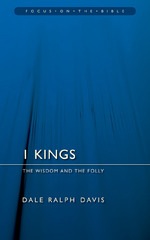
The Wisdom & the Folly - Dale Ralph Davis (1 Kings)

9781845502515
5 out of 5 - Refreshing, penetrating, biblical application & explanation

"Have you ever wondered why bits of the Bible are boring?" asks Dale Ralph Davis with refreshing honesty.

Such open honesty characterises this sane and sensible commentary on 1 Kings. Perhaps the words 'sane' and 'sensible' give the impression that the book is itself rather dull and boring, but not so.

In a way that is refreshing, humorous and penetrating Davis opens up the book of 1 Kings and provides sound, wholesome teaching. It is only when you look in the footnotes at some of the weird and wonderful interpretations from various scholars that you begin to appreciate the quality of what Davis is giving to you. His quick-fire no-compromising-with-scripture demolition job of these authors, coupled with his simple clarity, reassures the reader that, in the words of Dick Lucas, we are in "a safe strong pair of hands to guide us through the treasure - and the uninspiring bits - of 1 Kings."

This is a superbly easy-to-read book on 1 Kings. There is clear explanation, and there is excellent illustration, with the central theme of each section being plainly set out. But the thing I liked best was the incisive application. It is not possible to read this book and feel unchallenged.

But what is there to be learnt? Davis guides us through such themes as the majesty of God, prayer, wise living, and God's faithfulness. He brings a challenge to shake us out of our complacency.

Look out for other books by this author - he has also written on Joshua, Judges, 1 & 2 Samuel.

And why are bits of the Bible 'boring'? "Because they are the records of sinful men who simply repeat the sins and evil of those before them. Sin is never creative, but merely imitative and repetitious ... Evil carries a built-in yawn. 'And he walked in the ways of Jeroboam and in his sin.'"

Don't Waste Your Life - John Piper

dont_waste_your_life
5 out of 5 - Avoid the tragedy of a wasted life

This is a tremendous book; a great book to read at the start of another year. The vast expanse of the rest of our life (or the not so vast, God alone knows) stretches before us – the question hangs in the air: Will we waste it? What will we have to show at the end of our one and only precious God-given life?

Is Jesus useful only for escaping Hell, or is he the Treasure of our lives? Do we live lives that demonstrate something of the all-surpassing value of Jesus, or lives that show only too clearly that we have the same earthbound focus as our neighbours? Are we wasting our lives?

John Piper demonstrates with passionate forceful clarity that a life lived revelling in God’s glory and seeking to bring glory to him in every sphere of life is the only way to really live your life. He issues a call to serve and glorify Christ in the ministry, on the mission field, and in secular jobs. Amidst his passion there is balance and wisdom for all believers.

In the first two or three chapters, perhaps less easy to read than the rest of the book, Piper tells us of his discovery of the preciousness of Christ. And this is his great prayer for the readers of his book – that we will not only see it, but live it out. The succeeding chapters are powerfully challenging with titles like:
‘Risk is right – Better to lose your life than to waste it’
‘Living to prove He is more precious than life’
‘Making much of Christ 8 to 5’
‘The majesty of Christ in missions and mercy’

This isn't a book to read quickly, but a book that will take you time and will profoundly challenge you – your use of time, money and life itself. If you want to live life as God intends this is a book is for you. It should be compulsory reading for every Christian!

Not Even a Hint - Joshua Harris

9781590522554img
5 out of 5 - Straight-talking, honest, no-nonsense, non wishy-washy

Lust - a small word, a big problem. Have you ever thought, "Am I the only one struggling with these thoughts? Am I the only one who can't seem to control myself? Everyone else seems so untroubled, surely they can't know what it's like to be plagued with the constant barrage of filth that assaults my mind?"

Lust - maybe you think you're ok, you think you can handle your thoughts and feelings. Don't kid yourself - our enemy, the Devil, is extremely subtle. Perhaps you genuinely don't feel you have a problem with lust, but could it be that you are causing problems for others?

Lust - it ruins our relationships, with God and with each other, it robs us of our spiritual vitality, and it leaves a foul emptiness behind.

And this is something that affects the girls as well as the blokes.

How can we slay this demon that haunts us so persistently? What hope is there for those ensnared in its nets who have lost the hope of freedom? Joshua Harris deals with the problems that lust brings both to men and women, to young men and young women. He writes openly and honestly from his own personal experience, combining a biblical realism with practical wisdom as he sets out God's help for the battle.

This is a powerful book on dealing with sexual temptation. Harris doesn't miss and hit the wall; this is a straight talking book that deals openly and honestly with sexual purity. He does not go soft on sin. Yet it is a book that aims to "instil a love for holiness and a hatred for lust without dragging the reader's imagination through the gutter."

This is a practical book - there is a great chapter on the things that trigger lust, there is advice about dress sense and the impact that films, TV, books and music have on us. It is also a biblical book - He outlines God's high standard - "Not even a hint" - and then demonstrates how God provides the resources we need to make it a reality. There is an even greater chapter than the one mentioned earlier on how to fight lust's lies with the promises of scripture.

This is a book full of practical help, but above all it is a book that keeps bringing the reader back to the power of God not only to forgive, but to set us free.
Comment Comment |

The Cross he bore - Fredrick S. Leahy

29
5 out of 5 - Soul warming meditations on the Cross of Christ

"Gethsemane is not a field of study for our intellect. It is a sanctuary of our faith. Lord, forgive us for the times we have read about Gethsemane with dry eyes."

So ends the first of 13 brief, but profound, chapters on the sufferings of Christ. Here is a book to be read unhurriedly, a chapter at a time, and with time to think. It is a book that will deepen your understanding and appreciation of what Jesus went through at Calvary. It will help you grasp the depths of Christ's suffering, or at least to realise that they are beyond our grasp - what does it mean to be forsaken by God? What did he go through on the cross - this book will help you see beyond the physical suffering.

Prof Leahy brings us back to the cross to fill our hearts with gratitude to the one who "bore our sins in his body on the tree". This short book of meditations will spur you on in your love for Jesus. It will cause you to praise him with heartfelt thanks. It will show you the awfulness of sin by the immense price that Christ paid that we might be forgiven.

Often as you read it you will find yourself pausing to say, "Thank you, Lord".

I can't recommend this book highly enough.

End Times Made Simple: How Could Everybody be So Wrong About Biblical Prophecy - Samuel E. Waldron

endtimes
4 out of 5 - One of the sanest books on this subject ever

Does the 'Left Behind' series leave you confused? You maybe have an instinctive feeling that all that 'Left Behind' stuff isn't right, but you're not quite sure how to get to what you do believe about Christ's second coming. Or maybe you've never heard of the 'Left Behind' series and are just looking for some straightforward and convincing explanation of what will happen at the end of the world.

This is one of the sanest books on this subject ever!

With a subtitle of "How can everyone be so wrong about biblical prophecy?" this book lets you know from the start where it's coming from!

It's a great book for a number of reasons:

Instead of starting with the complicated passages in Revelation or in Daniel, it starts with clear and straightforward passages, like Jesus' teaching in the gospels. Once the basics have been established from the clear and straightforward passages the author moves on and uses what he has discovered in the clearer passages to determine what the more complex ones mean. That's a good rule for understanding Scripture.

This book isn't confined to simply looking at post, pre or amillennial viewpoints. It deals with many questions relating to Heaven and Hell, Christ's second coming, the state of believers after their death, the Day of Judgment, eternal punishments, the new Heavens and new earth, etc. On the way through he also deals with some common misunderstandings about Israel and the Church, confusion over which has led many into a mixed up theology on different points. It's a great handbook to have on anything to do with the end times.

It's also a practical book. Throughout the chapters the author shows the practical impact of the Bible's teaching on this subject to different areas of our lives.

It's also a relatively simple book. I was a bit sceptical of the title at first, but Waldron avoids excessive use of technical jargon, and is easy to follow. He throws in a few diagrams along the way to make matters even clearer. The most complicated bits are when he has to explain the complex schemes various men have come up with. It really is the 'end times made simple'.

Personally, I was glad to see such a clear and straightforwardly biblical book on the subject.

PS. Although he doesn't state it explicitly, Waldron is coming from an amillennialist position.

Questioning Evangelism - Randy Newman

questioning-evangelism
5 out of 5 - A Practical, helpful, and compassionate look at evangelism

Randy: How's the weather down there?
Grandma Belle: How could the weather be in Florida in the middle of July?

Randy: How's your family?
Aunt Vivian: Compared to whom?

In this way Randy Newman starts off his book on evangelism. Responding to a question with a question was the daily routine for Newman as he grew up in a Jewish home. Yet he points to Jesus, the master evangelist, as the supreme example in this. For Jesus answering a question with a question was the norm; a clear concise direct answer was a rarity. Take the rich young ruler for example - if ever there was a great opportunity to demonstrate how to explain the gospel this was it. Yet when asked, "What must I do to inherit eternal life?", Jesus responds, "Why do you call me good?"

Newman argues that so often we are too quick to answer, and that as we answer with our perfectly accurate answer, they aren't listening anyway. His point is that we need to engage their minds as well as simply present the truth. He says, "Answering a question with a question... brings to the surface the questioner's assumptions. It also takes the pressure off you... this is important because as long as we're on the defensive, the questioners are not really wrestling with the issues. They're just watching us squirm."

Throughout the book Newman illustrates with excerpts from his own work as a college evangelist over the last 20 years. With great openness he shows, not only the times he got it right, but also the times he got it wrong, and the lessons he learned from each occasion. He also gives practical suggestions throughout for questions you could ask, as well as giving dialogues to show how a conversation might go. These illustrations go along way to making the book practical, applicable, and easy to read. There is also a gentleness throughout the book that is extremely winsome. His way is not a triumphalist approach to evangelism, seeking to display wisdom and crush the opposition with knowledge, but a gentle way, seeking to understand the questioner, and seeking to provide real answers.

The book is divided into three sections, each full of useful content:

Part 1 - "Why ask questions?" - deals with the rationale and principles behind asking questions.
In Part 2 - "What questions are people asking?" - Newman shows how to, and how not to, answer questions like, `Why are Christians so intolerant?' `Why are Christians homophobic?' `Why does a good God allow suffering?'. There is a lot of practical wisdom packed into these chapters.
The third part - "Why aren't questions and answers enough?" - he turns the focus towards ourselves and deals with our lack of compassion for the lost, the problem of when our disgust at sin becomes disgust at the sinner, and how we can fail to listen.

Newman speaks about recognising the `fool' of Proverbs who shouldn't be answered, of how and when to ignore questions, he speaks of asking questions to discover what really lies behind the original question, of grasping the hurt that someone has been through that may be disguised in a casual question.

As well as providing a useful method for evangelism Newman also conveys a lot of useful facts on a variety of topics that will strengthen the believer in their faith. This is a great book that will equip you for evangelism, and give you a way of thinking that will be much more useful than simply learning a set of rules or facts.

Buy it and implement it

War & Grace - Don Stephens

war-and-grace
5 out of 5 - The triumph of God amidst the turmoil of man

This is a collection of short biographies from World War II. It recounts what God did through some of teh key and women caught up in the war. What a wonderful book. Not only did it encourage me to read of God's amazing grace, but it stirred my heart with compassion.

Stephens is a man who has had a passion for WWII, but he also has a passion for communicating the life-changing grace of the Lord Jesus Christ, and this shows in his writing. He has been collecting this information over the last number of decades, and he assembles it here in a series of thrilling accounts.

Like most males, war has held a fascination for me, especially the two world wars. I grew up on a diet of Victor, Battle and Warlord comics, and the little 'Commando' comic story booklets. The tales of bravery and courage were inspiring. But I never really had heard much of what God was doing in those years. Here Stephens fills the void.

Not only does he show the courage and the stand Christians took, but he shows how God worked to bring hate-filled atheists to Christ and turned them into powerful missionaries.

I had heard of some of names before: William Dobbie, the defender of Malta; Mitsuo Fuchida, the lead pilot in the Pearl Harbour attack. I had read about some of them before: Charles Fraser-Smith, the real 'Q'; Donald Caskie, Scottish pastor in France who ran an escape route for airmen and soldiers. But often in newspaper reports and in books written about them their faith is left aside. Stephens redresses the balance and brings out overpowering influence of the gospel in their lives.

Perhaps for me the highlight was the story of Henry Gerecke, chaplain to the highest ranking Nazis at the Nuremberg trials. His account of taking the gospel to these men and the resultant effects is quite startling and shows the shocking nature of grace at its best.

It really is a triumph of grace.

One of the things that impressed me was that Stephens writes with discernment - unlike some Christians he doesn't claim every religious person was actually a Christian. Nor does he accept that every profession made, for example by the Nazi war criminals, was necessarily genuine. This isn't a rose-tinted view of God's work in the war. He also corrects errors that have been made in other biographies, or obituaries, or films and provides a helpful balance.

If, like me you grew up on a diet of Victor comics and war films, and your shelves are filled with novels by Leon Uris and Cornelius Ryan, then this is a book you will enjoy.

The Jesus Storybook Bible - Sally Lloyd-Jones

0310708257
3.5 out of 5: A Brilliant idea - let down by the drawings and some inaccuracies

I've just finished preaching an overview of the bible - I'm passionate about gettting people to see the big picture. So I was really excited to see this for children. The idea is superb, and the tying of every story to Jesus is magnificent. Our 4 year old daughter has started seeing the connections already. And that excites me. I love how it fits every story in with the plot-line of the bible.

However I have a couple of caveats.

Since children get so much from imagery I was really disappointed with the artwork. The quality is great, but the content very poor, and underscores misconceptions of the bible, actually making the bible look less believable. Noah's ark is shown balancing precariously on the pinnacle of the mountain, as well as being that silly shape that it is often drawn - nothing like the proportions given in the bible. Jericho is a five house town - not much of a conquest there. Goliath is make to look like a gruesome ogre of fairytale proportions. The people of Israel coming to the Red Sea look like a small Sunday school outing rather than 1.5 million people making the exodus. I could go on. For me, the pictures undermine the very thing the words are seeking to do - they push the stories into the realm of fairy tales.

(A far better set of illustrations are by Gail Schoonmaker in the The Big Picture Story Bible written by David Helm.)

The other caveat is that sometimes Lloyd-Jones is a little loose to the story, making up things that aren't in the passage. For example - Jesus being bathed in a golden light at his baptism, there being three wise men, and others. I'd prefer not to have to edit the story as I tell it.

Having said all that - the links to Jesus often make you stop and praise God for Jesus. We've read it following on from the aforementioned Big Picture Story Bible - which I would heartily recommend.

Looking forward to the revised edition of this potentially tremendous asset.